


Standing out in the crowded market of Massachusetts, Connecticut, and Rhode Island takes more than clever taglines or polished logos. Customers crave a real connection with local businesses, and nothing forges that bond faster than authentic storytelling through lifestyle photography. By capturing genuine moments in real-life settings, your brand can express its values and personality in ways that spark loyalty and trust. Discover how shifting beyond basic product shots can turn your business into a recognizable, relatable favorite.
Table of Contents
- Defining Lifestyle Photography In Branding
- Types Of Brand Lifestyle Photography Sessions
- Key Elements For Authentic Storytelling
- How Lifestyle Images Enhance Brand Identity
- Common Pitfalls In Brand Photography
Key Takeaways
| Point | Details |
|---|---|
| Authenticity is Key | Lifestyle photography showcases real moments and genuine interactions, building trust and emotional connections with your audience. |
| Focus on Storytelling | This approach emphasizes narratives over traditional product displays, effectively engaging customers through relatable scenarios. |
| Consistency Matters | A cohesive visual style across images strengthens brand identity and ensures a memorable impression on viewers. |
| Choose the Right Approach | Selecting suitable session types tailored to customer needs enhances the storytelling and emotional impact of your brand’s imagery. |
Defining Lifestyle Photography in Branding
Lifestyle photography in branding captures the authentic story and values of your business. It goes far beyond showing products on white backgrounds or standard headshots. Instead, it depicts your brand within real-life situations, genuine interactions, and everyday moments that matter to your customers.
The core difference lies in approach. Traditional product photography isolates items and highlights features. Lifestyle branding photography shows products in natural, atmospheric settings where real people use them, creating context and meaning. This method builds trust because it feels authentic rather than polished.
What makes lifestyle photography different:
- Focuses on emotions and experiences, not just product specifications
- Shows your brand values through real-world scenarios and authentic interactions
- Creates narratives that resonate with your target audience’s lifestyle
- Emphasizes storytelling over sales tactics
- Demonstrates how products fit into actual customer lives
For small business owners in Massachusetts, Connecticut, and Rhode Island, this approach is particularly powerful. Your customers want to see themselves in your brand’s story. They want to understand how your products or services solve real problems they face daily.
Authentic storytelling strengthens brand identity and customer loyalty. When consumers see genuine scenarios instead of staged advertisements, they develop stronger emotional connections to your brand. This connection translates directly into trust, repeat business, and word-of-mouth recommendations.
Consider the difference between a coffee shop showing a perfectly styled latte versus a customer enjoying that same drink while working at a local café table. The second image tells a story your audience recognizes and relates to.
Here’s a quick comparison of lifestyle vs. traditional product photography approaches:
| Aspect | Lifestyle Photography | Traditional Product Photography |
|---|---|---|
| Visual Setting | Real-life environments | Isolated studio backgrounds |
| Emotional Connection | Builds authentic trust | Focuses on features only |
| Brand Value Impact | Highlights business mission | Rarely conveys values |
| Customer Engagement | Resonates with audiences | Less relatable or memorable |
| Content Use Cases | Social, website, campaigns | Catalogs, e-commerce listings |
Why this matters for your brand:
- Builds authentic connection with your local community
- Differentiates you from competitors using generic stock photos
- Creates content that performs better across social media and marketing channels
- Establishes a unified brand narrative across all touchpoints
- Shows rather than tells your brand’s values and mission
Lifestyle photography works because it transforms your brand from an abstract concept into a lived experience your customers already understand.
The goal isn’t perfection. It’s relatability. It’s showing the real moments, the genuine smiles, the authentic interactions that define what your business stands for and how it fits into your customers’ lives.
Pro tip: When planning lifestyle photos for your brand, think about the specific moments your ideal customers experience with your business, not just the products you sell. Capture the experience of working with you, not just the transaction.
Types of Brand Lifestyle Photography Sessions
Brand lifestyle photography isn’t one-size-fits-all. Different session types serve different purposes, and understanding which ones fit your business helps you build the right emotional connection with your audience.
The most common approach is candid workspace photography. These sessions capture your team doing actual work, collaborating on projects, or interacting naturally in your office or production space. Customers see the real people behind your brand, building trust through authenticity.

Team and people-focused sessions highlight your employees and company culture. Whether it’s capturing your leadership team, staff interactions, or behind-the-scenes moments, these images show that real humans run your business. For small businesses in Massachusetts, Connecticut, and Rhode Island, this personal touch resonates strongly with local customers who value relationship-based business.
Lifestyle sessions focus on capturing natural, storytelling images that display the broader culture and context around your products or services. This differs from traditional headshots or formal product photography.
Common session types include:
- In-action product documentation: Products being used or created in real environments
- Daily operations capture: Your actual workflow, processes, and business rhythm
- Customer interaction moments: Staff helping clients, delivering services, or building relationships
- Company culture storytelling: Team events, office spaces, and company values in action
- Branded lifestyle scenarios: Styled but authentic scenes showing how products fit into customer lives
Some sessions blend styles. You might combine brand photography that visually communicates your personality with genuine candid moments, creating a narrative that feels both intentional and real.
This summary shows common lifestyle photography session types and their branding benefits:
| Session Type | Branding Benefit | Example Scenario |
|---|---|---|
| Candid Workspace Photos | Reveals real team and culture | Team collaborating onsite |
| In-Action Product Shots | Shows authentic product use | Coffee served to working client |
| Customer Interaction Moments | Builds credibility and trust | Staff assisting customers |
| Company Culture Storytelling | Communicates values visually | Team event or staff celebration |
Location matters significantly. Shooting in your actual workspace, at client locations, or in environments where your customers interact with your brand creates natural context. A software company photographed in their office tells a different story than one shot in a coffee shop, even if the team is the same.
The duration and scope varies too. Some sessions take 2-3 hours capturing moments in a single location. Others span multiple days, locations, or even months of occasional photography to build a comprehensive visual library.
The best session type matches where your customers encounter your brand and what story you need to tell about your business.
Think about what questions your ideal customers ask about your business. Do they wonder what your workspace looks like? Who’s on your team? How you deliver your product or service? Your session type should answer those questions visually.
Pro tip: Choose session types based on customer objections or questions you hear most often, not just what looks visually appealing. If prospects ask “How do you actually do this?” a process-focused session answers better than a lifestyle moment alone.
Key Elements for Authentic Storytelling
Authentic storytelling in brand photography isn’t about perfection. It’s about capturing moments that reveal who you really are and what your business actually does.
The foundation starts with real moments over staged scenes. Your customers can spot artificial setups instantly. When they see genuine interactions, actual workflows, and unscripted smiles, they believe what they’re seeing reflects reality.
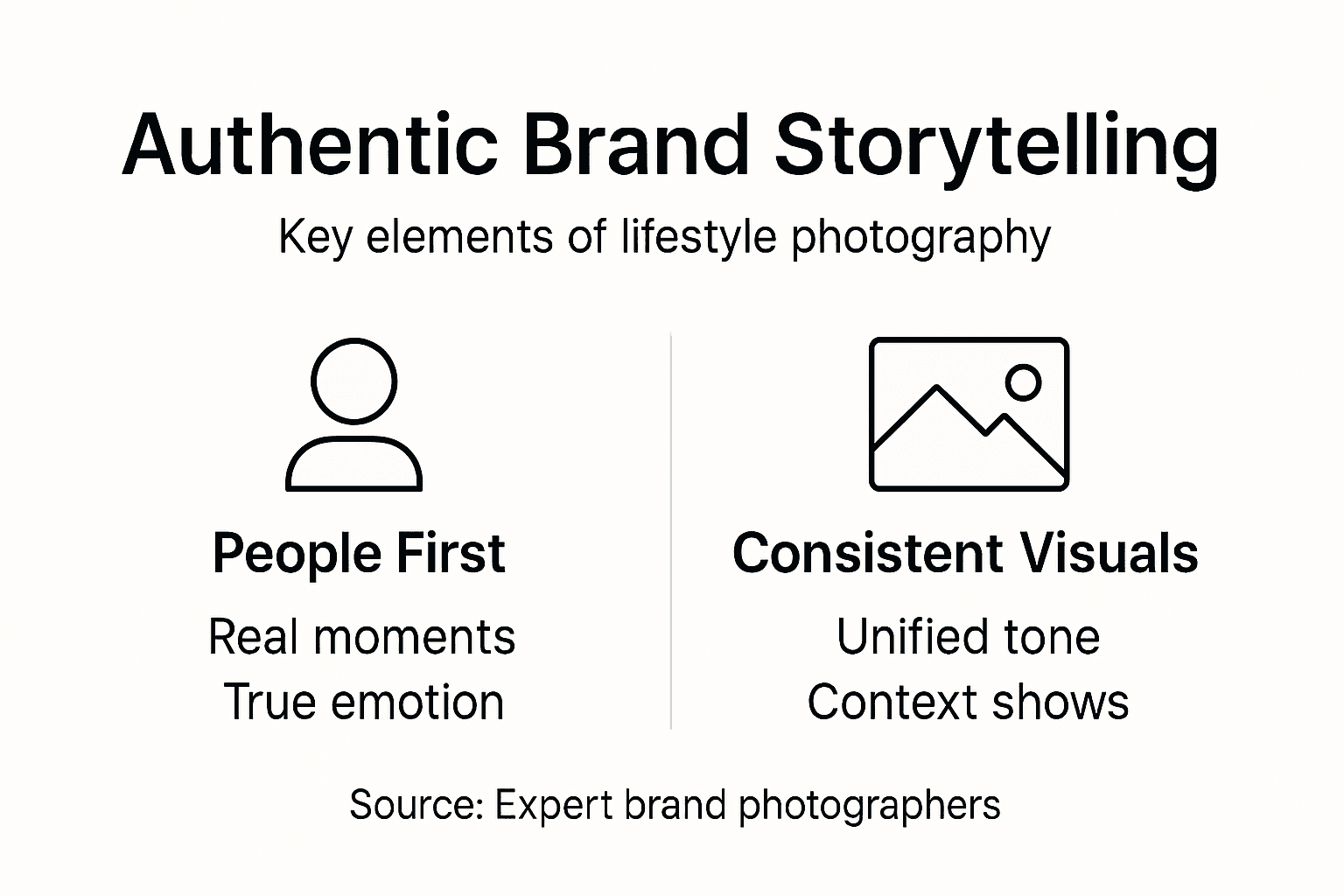
Visual consistency across images helps maintain brand identity while telling your story. This doesn’t mean every photo looks identical. Rather, it means your color palette, lighting style, and overall aesthetic feel connected and intentional.
Emotional resonance matters more than technical perfection. A slightly imperfect photo that shows real connection outperforms a flawlessly composed image with no soul. Your audience connects with feelings, not pixel-perfect composition.
Key storytelling elements include:
- Integration of products naturally: Show what you sell within actual use cases, not isolated on white backgrounds
- Diverse perspectives: Capture your brand from multiple angles—team, customers, processes, workspace
- Meaningful experiences: Focus on moments that matter to your audience, not just what looks pretty
- Consistent visual style: Maintain recognizable aesthetics across all images
- Authentic interactions: Real conversations, genuine laughter, honest moments
Context transforms generic images into powerful stories. A photo of your team member delivering a service tells a story. That same team member helping a customer solve a real problem tells a compelling story. The difference is context.
For small business owners in Massachusetts, Connecticut, and Rhode Island, this means showcasing what makes your business different locally. Are you the shop owner who remembers customer names? The service provider who goes above and beyond? The maker who talks to customers about your craft? That authenticity is your story.
Visual storytelling that conveys your brand’s personality requires collaborative planning between you and your photographer. You understand your business deeply. Your photographer understands how to capture that visually. Together, you create images that feel true.
Authentic storytelling works because your audience already knows when something is real. Show them reality and they’ll believe in your brand.
Think about the moments that make your customers choose you. The personal touch? The expertise? The quality? The care? Those moments deserve to be photographed and shared.
Pro tip: Before your photography session, write down three stories your customers tell about your business. Use those real stories as the foundation for what you photograph, ensuring every image connects to actual customer experiences.
How Lifestyle Images Enhance Brand Identity
Your brand identity isn’t just your logo or color scheme. It’s the feeling people get when they interact with your business. Lifestyle photography transforms that feeling into visual form.
When customers see your brand represented through genuine moments and real people, they connect emotionally rather than transactionally. This connection builds loyalty that lasts far longer than any discount or promotion.
Lifestyle photography captures your brand’s mission, values, and voice through authentic, relatable moments that show people, products, and places in real contexts. This makes your brand more personable and memorable to your audience.
Brand identity strengthens through consistency. Every lifestyle image should feel like it belongs to your brand, not a generic stock photo library. Your color palette, the way people interact, the environments you choose—all of these reinforce who you are.
Lifestyle images accomplish what words alone cannot:
- Build immediate recognition: Consistent visual style becomes synonymous with your brand
- Show, don’t tell: Demonstrate your values through action, not marketing language
- Create emotional bridges: People remember how images made them feel more than what they saw
- Establish credibility: Authentic photos signal transparency and trustworthiness
- Differentiate from competitors: Your real story beats generic competitor imagery
Consider the difference between reading “We care about customer service” versus seeing your team genuinely helping a customer solve a problem. The image proves the promise.
For Massachusetts, Connecticut, and Rhode Island businesses, this matters even more. Your customers likely prefer local businesses. Lifestyle photography shows them the actual people and places behind your brand, fulfilling that preference visually.
Your brand identity also communicates through what you choose NOT to show. If you emphasize quality craftsmanship, your images focus on skilled hands and detail work. If you prioritize community connection, your images show real relationships. These choices reinforce identity consistently.
The cumulative effect is powerful. Over time, when customers see your lifestyle images across social media, your website, and marketing materials, they absorb your brand identity at an emotional level. They stop seeing you as “just another business” and start seeing you as “the business that stands for this.”
Lifestyle photography doesn’t just show your brand—it becomes your brand in the minds of customers.
This visual identity extends far beyond marketing. It influences how employees feel about working for you, how partners perceive your values, and how customers speak about you to others.
Pro tip: Audit your current business photos and ask yourself: Would someone recognize this is my brand? Do these images communicate my actual values? If the answer is no, lifestyle photography will transform how your brand is perceived.
Common Pitfalls in Brand Photography
Most brand photography fails for predictable reasons. Knowing what to avoid saves you time, money, and the frustration of unusable images.
The biggest mistake is ignoring brand identity alignment. A photo might be technically perfect but feel nothing like your brand. If your images don’t reflect who you actually are, they confuse your audience instead of connecting with them.
Poor lighting, distracting backgrounds, and weak composition reduce the impact of your visual storytelling significantly. A beautiful moment can disappear behind messy details or flat, uninviting lighting that makes everything look amateur.
Lack of visual consistency across your images creates confusion. One photo has warm tones, another is cool and clinical. One shows polished professionalism, another feels casual and relaxed. Your audience struggles to understand what your brand actually represents.
Common mistakes to avoid:
- Staging products unnaturally: Show real use cases, not awkward posed setups
- Insufficient collaboration with photographer: Your photographer needs to understand your brand deeply
- Overshooting similar images: Variety in composition, angles, and context matters
- Choosing distracting backgrounds: Focus attention on what matters, not clutter
- Ignoring lighting quality: Natural light and proper artificial lighting transform images
Another frequent error is treating brand photography like product photography. You’re not just showing what you sell—you’re showing why it matters and who uses it. The emotional context matters more than perfect product presentation.
For Massachusetts, Connecticut, and Rhode Island businesses, a specific pitfall emerges: over-reliance on stock photos. Your competitors use the same generic images. Your real team, actual workspace, and genuine customer interactions are what differentiate you. Stock photos work against authentic branding.
Many small business owners also skip the planning phase entirely. They book a session, show up, and hope something good happens. Without clear goals about what story you’re telling, you end up with random images that don’t work together cohesively.
Avoiding mistakes like lack of visual consistency and insufficient collaboration helps produce meaningful content that effectively communicates your brand’s story and values across all platforms.
Bad brand photography isn’t just wasted money—it actually damages your brand perception by appearing inauthentic or unprofessional.
Timing matters too. Rushing a photography session to save money almost always backfires. Quality brand photography requires preparation, proper lighting, and thoughtful direction.
Pro tip: Before your photography session, create a detailed shot list with your photographer covering specific brand moments you want captured. This prevents rambling sessions that produce few usable images and ensures you leave with exactly what you need.
Elevate Your Brand with Authentic Lifestyle Photography
Struggling to create an emotional connection that truly reflects your brand’s story? The challenge lies in showcasing genuine moments that resonate with your audience and distinguish your business in Massachusetts, Connecticut, and Rhode Island. At Jodi Blodgett Photography, we understand the power of branding photography to build trust through authentic storytelling and natural interactions that bring your brand to life.

Discover how working with a New England brand photographer can transform your visual identity by capturing the real experiences behind your products and services. Visit https://jodiblodgettphotography.com today to book your session and start building an emotional connection with your customers that lasts. Don’t wait to turn your brand story into powerful, relatable images your audience will remember.
Frequently Asked Questions
What is lifestyle photography for brands?
Lifestyle photography for brands captures real-life moments and interactions, showcasing products in authentic settings to build emotional connections with customers.
How does lifestyle photography differ from traditional product photography?
Lifestyle photography emphasizes real-world scenarios and emotional engagement, whereas traditional product photography typically focuses on isolated products and features.
Why is emotional connection important in lifestyle photography?
Emotional connections foster trust and loyalty among customers, making them more likely to engage with a brand and return for repeat business.
What are some common types of lifestyle photography sessions?
Common types of lifestyle photography sessions include candid workspace photography, in-action product documentation, customer interaction moments, and company culture storytelling.